How to Make Money with n8n Automation in 2026 (Real Numbers)
The market for automation services is real and growing. Businesses are drowning in manual processes that a competent n8n user could eliminate in a few hours — and most of those businesses have no idea n8n exists. That gap is where the money is. What's less clear is which income model actually works at what stage, what you realistically charge before you have a portfolio, and how to get from "I just learned n8n" to "I have three paying clients." Those are the questions this breakdown answers.
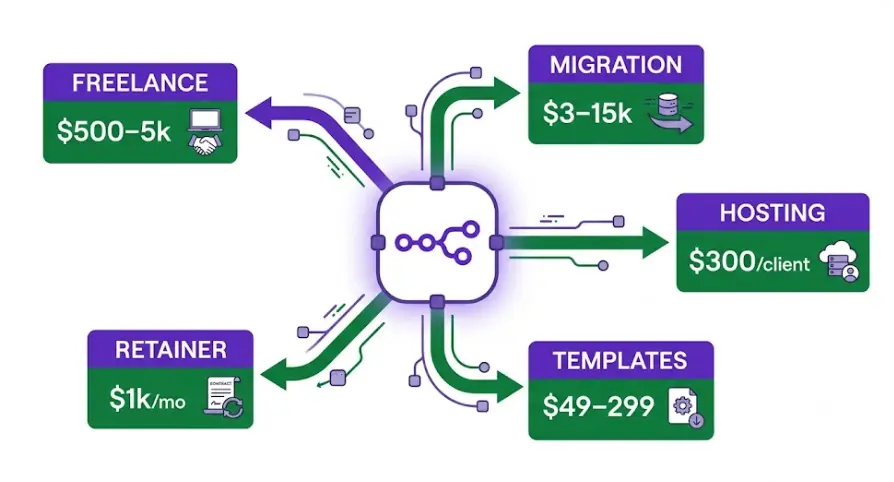
Income ranges at a glance
The realistic 6-month target for someone learning n8n seriously: $2,000–$5,000/month from 2–3 retainer clients plus occasional project work. Getting to $10,000/month typically takes 12–18 months and requires either a strong niche, an agency model with subcontractors, or a white-label SaaS business running at scale. Neither is a get-rich-quick situation — but both are achievable without prior technical experience if you approach it systematically.
In this guide
- What you actually need to know before charging clients
- Model 1: Freelance project builds ($500–$5,000)
- Model 2: Monthly retainers ($500–$3,000/client)
- Model 3: Migration projects — Zapier/Make to n8n ($3k–$15k)
- Model 4: Template sales on Gumroad/Lemon Squeezy (passive)
- Model 5: White-label n8n hosting (recurring SaaS margin)
- What automations clients actually pay for
- How to get your first client (specific tactics)
- Realistic timeline to income
- FAQ
What You Actually Need to Know Before Charging Clients
The question isn't "do I know enough n8n" — it's "do I know enough n8n to reliably solve this specific type of problem for this specific type of client?" Those are different bars. You don't need to know how to build a complex LangChain-based AI agent before you charge $500 to automate a law firm's intake form into their CRM. You need to know webhooks, HTTP requests, conditional logic, and how Clio's API works. Scoping what you know well enough to sell is the first real skill.
That said, there's a minimum floor. If you're still looking up how to parse JSON or why a Set node outputs a different shape than you expected, you're not ready to sell — not because those are hard skills, but because debugging client workflows under time pressure with your reputation at stake requires that the fundamentals be automatic. Most people hit that floor after 20–40 hours of building actual workflows (not watching tutorials). If you want a structured path, our n8n tutorial for beginners covers the core mechanics, and the n8n automation examples article gives you 15 real workflow patterns to build and adapt.
The skills that actually make you money at a premium rate aren't n8n-specific — they're the same skills that make any consultant valuable: understanding what a business actually needs (which is never "a webhook"), translating vague requirements into specific workflow specs, and communicating clearly when something will take longer than expected. A technically weaker n8n user who handles the client relationship professionally will out-earn a technically stronger one who disappears for weeks between updates.
Skills vs income tier
| Skill level | What you can build | What you can charge |
|---|---|---|
| Beginner (20–40 hrs) | Webhook → CRM, form notifications, simple API calls, Slack alerts | $200–$800/project · $25–$50/hr |
| Intermediate (60–100 hrs) | Multi-branch logic, error handling, scheduled data pipelines, API auth flows | $800–$3,000/project · $50–$100/hr |
| Advanced (150+ hrs) | AI agents, sub-workflow architectures, migrations, custom code nodes, SaaS backends | $3,000–$15,000/project · $100–$200/hr |
The n8n learning curve is steeper than Zapier but shallower than writing Python from scratch. If you've never automated anything before, plan for 4–6 weeks of part-time work before you're confident enough to take a paid project. If you have experience with any automation tool — Zapier, Make, Power Automate — you'll transfer most of the mental model and need 1–2 weeks to get comfortable with n8n's interface and expression syntax. See our full review of what n8n can and can't do in 2026 if you're evaluating whether to invest in learning it at all.
Model 1: Freelance Project Builds
One-time workflow builds
The most accessible entry point: someone needs a workflow built, you build it, they pay you. Platforms like Upwork and Fiverr have dedicated n8n categories with consistent demand — search "n8n" on Upwork and you'll typically see 50–120 open jobs at any given time, ranging from $100 quick fixes to $5,000+ complex integrations. The quality of clients on freelance marketplaces is lower than direct outreach, but the barrier to your first $500 is much lower.
Pricing a project-based engagement correctly requires understanding the difference between what a workflow takes to build and what it's worth to the client. A lead routing workflow that takes you 6 hours to build shouldn't be priced at 6 × $75 = $450 — it should be priced based on what the client would pay a full-time employee to do that task manually. If a business owner was spending 2 hours per day manually moving leads from a form into a CRM, that's 40 hours/month of $30/hour labor = $1,200/month. A workflow that eliminates that entirely is worth $1,500–$3,000 to build, regardless of how quickly you can actually build it. The mistake beginners make is pricing their time instead of pricing the value.
On Upwork specifically: your first few projects will be at below-market rates because you lack reviews. Accept that reality, do excellent work, get reviews, and raise your rates after 5–10 completed projects. An Upwork profile with 10 five-star reviews for automation work commands $75–$120/hour without negotiation. Getting from zero to 10 reviews takes most people 2–4 months of consistent bidding.
What a typical project month looks like at intermediate level
Model 2: Monthly Retainers
Ongoing automation management
Retainers are the most financially stable income model for automation freelancers — recurring revenue that you can plan around, with clients who already trust your work and don't need to be sold from scratch each month. The pitch to a client is simple: their workflows break when APIs change, when new apps are added, or when business processes evolve. Instead of calling you each time and negotiating a one-off rate, they pay a monthly fee that covers maintenance, small improvements, and monitoring. For many clients, the predictability of that arrangement is worth paying a premium for.
A well-structured retainer package typically includes: guaranteed response time for workflow issues (24–48 hours is standard), a monthly hours bucket (usually 4–8 hours for basic packages, 12–20 for premium), quarterly reviews of the automation stack to identify inefficiencies, and priority booking for larger project work. The hours bucket is important — it sets a concrete expectation for both sides. Most months, maintenance takes 2–4 hours per client; some months it's zero. The retainer normalizes that variability into a flat fee.
Getting to 5 retainer clients at $1,000/month each means $5,000/month from roughly 20–25 hours of maintenance work — the equivalent of a $200–$250/hour effective rate with much less selling than project work requires. The challenge is that retainer clients require trust you haven't built yet with new prospects. The most reliable path to retainers is converting project clients: after successfully delivering a build, offer a maintenance package at a discount from your hourly rate. Clients who've seen you work are far more likely to say yes than cold prospects.
Learn n8n from Zero to Client-Ready
The LearnForge AI Apps course teaches you to build production n8n workflows and AI agents — the exact skills automation clients pay for. Module 0 is completely free.
Try Free Lesson →Model 3: Migration Projects — Zapier and Make to n8n
Platform migration projects
This is currently the highest-margin single project type in the n8n ecosystem, and it's being driven by a real market dynamic: companies that built their automation stack on Zapier or Make 2–3 years ago are hitting painful cost walls as their usage has scaled. A Zapier bill that was $299/month at 10,000 tasks is now $799/month at 50,000 tasks, and the logic for switching is obvious — n8n's execution-based pricing means that same volume on n8n self-hosted costs $20–40/month in VPS fees. The savings pay for a migration project in 2–3 months.
The value proposition you're selling is the audit + migration + knowledge transfer: you document the existing automation stack, rebuild it in n8n with improvements, and leave the client with a documented system they understand. Most businesses attempting this themselves underestimate how long the documentation and testing phase takes — which is exactly where your expertise becomes valuable. Billing $5,000–$8,000 for a 2-week migration project that saves the client $500/month is an easy conversation; the ROI is visible within a year.
Finding migration clients doesn't require cold outreach. People actively searching "Zapier alternative cheaper" and "move from Zapier to n8n" are already sold on the idea — they just need someone to execute it. A blog post (like this one) or a LinkedIn post explaining the cost math with a call to action is a reliable lead source. We've seen the comparison article between n8n vs Zapier drive significant inbound interest from businesses already running Zapier who didn't realize how much they were overpaying.
Sample migration project economics — medium-complexity Zapier stack
Model 4: Selling Workflow Templates
Passive template sales
Selling n8n workflow templates is the most honest "passive income" in this space — once a template is listed and has traffic, every sale is pure margin. The mechanics are straightforward: export your workflow JSON, write documentation explaining what it does and how to configure it, price it, and list it on a digital marketplace. Buyers pay, download the file, import it into their n8n instance, and you've received money for something you built once.
The realistic caveat: templates don't sell themselves, and building a catalog that generates meaningful recurring income takes time. A single template priced at $49 on Gumroad with no traffic will sell zero copies. The same template promoted in relevant communities, featured in a blog post with SEO traffic, or linked from a YouTube tutorial can sell 20–50 copies per month. The income is passive; the marketing is not. People who report $2,000–$5,000/month from template sales typically have 5–15 templates across multiple marketplaces, a presence in automation communities, and some form of traffic source.
What sells well: industry-specific templates that save research time (lead enrichment for B2B SaaS, invoice processing for agencies, social media scheduling for content creators), and workflow bundles that solve a complete business process end-to-end rather than a single trigger-action step. Generic templates compete with the free templates on n8n's official library; specialized templates for a specific stack (e.g., Notion + Airtable + Slack for remote teams) command $99–$199 and face far less competition.
| Platform | Fee | Built-in traffic | Best for |
|---|---|---|---|
| Gumroad | 10% per sale | Low — you bring traffic | Getting started, simple setup |
| Lemon Squeezy | 5% + $0.50 | None — SEO-only | Better margins at volume |
| n8nmarket.com | Varies | Medium — n8n-specific buyers | Targeted n8n audience |
| Your own site | 0% (+ payment processor) | None — SEO/content required | Maximum margins, full control |
Model 5: White-Label n8n Hosting
Running n8n as a managed service for clients
This model is underutilized relative to its economics. The idea: you run a self-hosted n8n instance on a VPS, configure client environments within it, and charge clients a monthly fee for their managed automation environment. From the client's perspective, they get a fully functional n8n setup without having to manage servers, worry about updates, or deal with any infrastructure. From your perspective, one server costing $40–60/month hosts 10–20 clients who each pay $200–$400/month — the math is compelling.
The margin profile on this model at maturity is exceptional. A Hetzner CX32 server (4 vCPU, 8 GB RAM) at €8.29/month handles 15 active small-business clients without resource contention — each client running 5–10 active workflows at moderate frequency. If those 15 clients pay $300/month each, that's $4,500/month in revenue from $10/month in server costs. Your actual time investment per client is 2–3 hours to onboard, 30–60 minutes per month for maintenance, and occasional support. At 15 clients, plan for 20–25 hours of ongoing work per month — an effective rate of $180–$225/hour.
The challenge this model introduces is operational responsibility. When a client's workflow breaks at 11pm, it's your infrastructure. When you need to update n8n across your hosted instance, you need to test carefully so you don't break anything for existing clients. This is manageable — n8n updates are generally stable, and a proper staging environment reduces risk — but it's a different category of responsibility than pure consulting work. If you're comfortable with basic server management (which you learned setting up your own n8n instance per our self-hosted setup guide), adding client environments is primarily an operational process question, not a technical one.
White-label hosting economics — 15 clients on one Hetzner CX32
What Automations Clients Actually Pay For
Most businesses don't know what's automatable until you show them. The role of a good automation consultant isn't just to build what's requested — it's to look at a business's operations and identify where manual, repetitive, error-prone processes are burning time and money. The workflows that are easiest to sell are those that tie directly to revenue or are clearly replacing expensive human time.
Lead capture and follow-up sequences — $800–$3,000
Capturing leads from forms, ads, or scraping → enriching with Apollo or Clearbit → scoring and routing to the right salesperson → triggering a personalized email sequence. Every business that runs paid advertising needs this, and most are doing parts of it manually. Easy ROI conversation: "if this automation captures 3 more leads per week that close at your average deal size, it pays for itself in month one."
CRM sync and data hygiene — $1,000–$4,000
Keeping data consistent across multiple tools — syncing HubSpot with an internal database, de-duplicating contacts, enriching company records, updating deal stages based on email activity. Agencies and SaaS companies with sales teams will pay premium prices for clean CRM data because bad data directly costs them in missed follow-ups and wrong prioritization.
Automated client reporting — $500–$2,000
Pulling data from ad platforms, analytics tools, and CRMs → compiling into a formatted report → delivering via email or updating a live dashboard every Monday morning. Marketing agencies spend 4–8 hours per week per client on manual reporting. Automating that for $1,500 upfront and $200/month maintenance is a no-brainer for any agency owner who values their time correctly.
AI-powered triage and classification — $1,500–$5,000
Using n8n's AI Agent capabilities to classify incoming support tickets, route customer emails to the right department, summarize documents, or extract structured data from unstructured inputs. This category commands premium rates because it requires both n8n knowledge and understanding of LLM prompting — a combination most clients can't hire for internally.
Invoice chasing and payment tracking — $500–$1,500
Monitoring unpaid invoices in Stripe or QuickBooks → triggering reminder email sequences at 7, 14, and 30 days overdue → escalating to internal Slack alerts at 45+ days → logging all activity to a tracking spreadsheet. Any service business with net-30 or net-60 payment terms loses real money to late payments. A workflow that recovers even one extra invoice per month pays for itself immediately.
What doesn't sell well: Automations that solve a developer's problem rather than a business owner's problem. "Automated deployment notifications" or "CI/CD status webhooks" are technically interesting and genuinely useful, but the people who want them can usually build them themselves — and they know it. Sell to business owners and operations managers, not to developers.
How to Get Your First n8n Client
The fastest path is always the warm network. Every business you know personally that has employees doing repetitive tasks is a potential client. The pitch doesn't need to be polished: "I've been learning automation tools and I think I can save you 5 hours per week on [specific task you know they do manually]. Can I show you what it would look like for free?" The free first project removes all friction from the conversation and gives you a reference, a case study, and ideally a paying follow-up engagement.
Warm outreach to 10 businesses you know
Write a short message to founders, owners, or operations managers you know personally. Don't pitch automation in the abstract — mention one specific manual task you know they do. "I noticed your team manually sends follow-up emails after demos — I think I can automate that entirely." Specificity converts. Goal: one free project that produces a real result.
Upwork profile targeting Zapier/Make jobs (not just n8n)
Create an Upwork profile positioned as an "automation specialist" not an "n8n freelancer." Bid on Zapier and Make jobs — most clients don't care about the tool, they care about the result. Mention n8n as an option in your proposal with the cost comparison. Winning 2–3 projects at low rates to get reviews opens the path to your first $1,000–$2,000 projects.
Job board mining for automation signals
Search Indeed, LinkedIn Jobs, and Hnhiring for small businesses posting roles like "data entry assistant," "operations coordinator," or "admin assistant to manage spreadsheets." These postings are a direct signal that manual processes are happening. Cold outreach offering to automate those processes — framed as cheaper and more reliable than hiring — converts reasonably well because you're solving a problem they've already identified and are actively spending money on.
Reddit and community answer-first approach
In r/entrepreneur, r/smallbusiness, r/startups, r/zapier — people regularly post asking for automation help or complaining about tool costs. Answer their question genuinely in the thread (showing your expertise) and add a brief note that you do this professionally. Don't pitch in the first message. Community members who see you solve problems publicly reach out directly — no cold outreach required, just demonstrated competence.
LinkedIn content about automation ROI
A single LinkedIn post showing a specific automation you built — with before/after time savings and cost numbers — regularly generates multiple inbound inquiries. You don't need a large following. A post showing "this workflow saves my client 12 hours/week" with a screenshot of the n8n canvas will be shared in automation circles and seen by decision-makers who are actively looking for this kind of help. Post 2–3 times per week, focus on outcomes not technology, and expect the first inbound lead within 4–8 weeks.
Realistic Timeline to Income
The timelines below assume someone learning n8n while working part-time on client acquisition — roughly 15–20 hours per week. Full-time acceleration compresses these by roughly 40%.
| Timeframe | Expected milestone | Income range |
|---|---|---|
| Weeks 1–4 | Core n8n skills: webhooks, HTTP, branching, 10 practice workflows built | $0 (learning phase) |
| Weeks 4–8 | First paid project (likely via warm outreach or Upwork at low rate) · First review | $200–$800 |
| Month 3 | 3–5 completed projects · First repeat client or retainer conversation | $500–$2,000/mo |
| Month 6 | 2–3 retainer clients · specialization emerging · referrals starting | $2,000–$5,000/mo |
| Month 12 | Defined niche · 4–6 retainer clients · first migration project or template income | $5,000–$10,000/mo |
| Month 18+ | Agency model or white-label hosting · subcontractors · productized service | $10,000–$25,000/mo |
The variable that matters most isn't your n8n skill level — it's how fast you ship finished work and how aggressively you pursue client conversations. People who build lots of practice workflows but don't actively seek their first paying project often stay in the learning phase indefinitely. The fastest path to income is accepting imperfect early work at low rates, delivering real value, and iterating from there. The n8n automation examples we've documented — real workflows that real businesses use — give you a practical vocabulary of what's buildable and sellable without needing to invent use cases from scratch.
Frequently Asked Questions
How much can you make with n8n automation?
Income varies significantly by model: $500–$5,000 per freelance build, $500–$3,000/month per retainer client, $3,000–$15,000 for a Zapier-to-n8n migration, $29–$299 per template sale, and $200–$500/month per white-label hosting client. Most people running n8n as a primary income reach $3,000–$10,000/month within 6–12 months of consistent client work. Getting to $10,000+ requires specialization in a specific niche or an agency/SaaS model at scale.
How long does it take to learn n8n well enough to charge clients?
Most people can deliver their first paid project within 4–8 weeks of starting. The core skill set — webhooks, HTTP requests, conditional branching, data transformation — takes 20–40 hours of hands-on building to feel confident. You don't need to know everything before charging; you need to reliably solve one type of problem for one type of client. Specialization reaches chargeable skill faster than learning n8n broadly.
What kind of n8n workflows do clients actually pay for?
Lead capture and follow-up ($800–$3,000), CRM data hygiene and enrichment ($1,000–$4,000), automated client reporting ($500–$2,000), AI-powered email triage ($1,500–$5,000), and invoice chasing sequences ($500–$1,500). The common thread: automations that tie directly to revenue or replace expensive human time. Workflows where the ROI calculation is obvious are easiest to sell — if eliminating a 2-hour/day manual task justifies the cost in month one, the conversation is easy.
Is n8n better than Zapier for building a freelance automation business?
For freelancers, yes — for two structural reasons. First, you can self-host n8n and run dozens of client workflows on a $20–40/month server, so your infrastructure cost doesn't scale with client count. Second, n8n's AI Agent capabilities and code nodes let you build things impossible in Zapier, expanding the problems you can charge to solve. The tradeoff: steeper learning curve and more client education required. See our full n8n vs Zapier comparison for the technical details.
Where do I find my first n8n client?
Fastest: warm outreach to businesses in your network, offering one free workflow to demonstrate value. Second: Upwork, bidding on Zapier/Make/automation jobs (clients don't care about the tool). Third: Reddit communities where people ask automation questions — answer helpfully, mention you do this professionally. Fourth: mining job boards for "data entry" or "admin" postings that signal manual processes you can automate. LinkedIn content about specific automation ROI generates consistent inbound after 4–8 weeks of posting.
Can you make passive income with n8n?
Yes, through two models. Template sales on Gumroad or Lemon Squeezy ($49–$199/template) generate recurring revenue with no marginal cost per sale — five specialized templates with consistent traffic can produce $1,000–$3,000/month. White-label n8n hosting charges clients $200–$500/month to run their workflows on your self-hosted server; at 15 clients, that's $3,000–$7,500/month from roughly 25 hours of maintenance. Neither is passive at the start, but both become increasingly hands-off as the base stabilizes.
Related Articles
n8n Tutorial for Beginners — Build Your First Workflow
Step-by-step tutorial for building your first real n8n workflow — from installing to your first trigger, nodes, and live test.
n8n vs Zapier in 2026: Which One Should You Choose?
Pricing models, app integrations, AI agent capabilities, self-hosting — with real numbers and an honest verdict for each type of user.
How to Build AI Agents with n8n — Step by Step (No Code)
Build real AI agents with n8n's AI Agent node: memory types, live tools, debugging ReAct, and a full production support agent example.
Learn the Skills Automation Clients Pay For
The LearnForge AI Apps course teaches n8n, FlutterFlow, and AI API integration — the exact stack businesses are hiring for in 2026. Start with Module 0 completely free, no card required.
Start Free Lesson →