How to Start an Automation Agency with n8n in 2026
The gap between "n8n freelancer" and "automation agency" isn't a headcount — it's a business model. A freelancer sells a workflow and hands it over. An agency sells ongoing outcomes and stays on the hook. That distinction is worth $500–$3,000 per client per month in recurring revenue, because clients will pay a premium for the version where they don't have to think about whether their workflows are running. This guide covers the actual economics: what to charge, how many clients one person can handle before breaking, how to run 50 client workflows on a $40/month server, and what operationally goes wrong when you hit $5k/month. Most guides skip those parts.
Agency economics at a glance
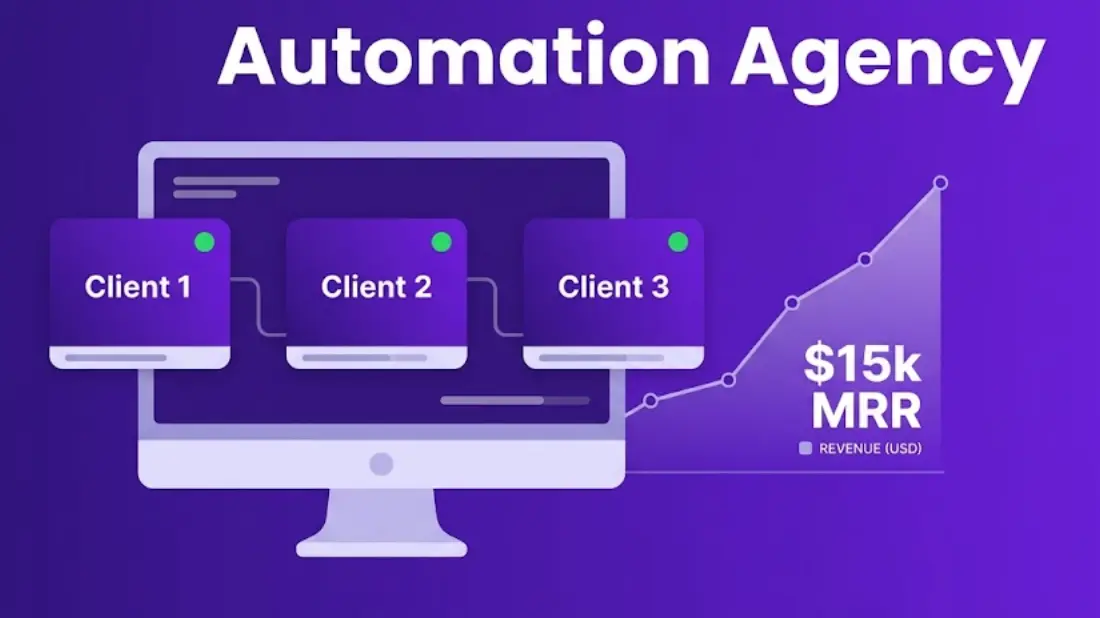
The margin figure deserves a moment. When your infrastructure cost is $30/month and you're charging 10 clients $1,500/month each = $15,000 MRR, your infrastructure margin is 99.8%. The real costs are your time and any subcontractors. That's why automation agencies have some of the best unit economics of any service business — and why the model is worth building deliberately rather than stumbling into as an accidental freelancer.
In this guide
- Agency vs freelancer — the structural difference that changes your revenue
- Setting up n8n infrastructure for multiple clients ($40/month, 50+ workflows)
- Choosing the right niche — the intersection that pays
- Service tier structure — what to include at each price point
- The client delivery process that converts projects to retainers
- Getting clients — what works and what wastes months
- The $5k/month wall — what breaks and how to get through it
- Month-by-month roadmap to $15k MRR
- FAQ
Agency vs freelancer — the structural difference that changes your revenue
Most people reading about "starting an automation agency" are actually thinking about freelancing with a more ambitious business card. That's fine as a starting point, but the distinction matters early because it changes how you price, what you promise, and how clients relate to you after the first delivery.
A freelancer builds a workflow, tests it, hands over the JSON export and the documentation, collects payment, and moves on. The client now owns the workflow and is responsible for everything that happens to it. If it breaks in three months because an API changed, the client either pays the freelancer again or figures it out themselves. This is a reasonable arrangement, and for one-time projects it's what clients expect.
An agency does something different: it keeps the workflow running on its own infrastructure, monitors it, fixes failures before clients notice them, and is the first call when something stops working. The client doesn't get a file — they get a running system. That distinction is what justifies a monthly fee after the initial build is done, and it's what separates $800 one-off projects from $1,500/month relationships that continue indefinitely.
The practical implication: if you want to run an agency, you need to host workflows yourself. Which is both the constraint and the advantage. Your infrastructure cost is $30–40/month regardless of how many client workflows you're running. At 10 clients paying $1,500/month, your infrastructure margin is essentially 100% — the server handles all 10 clients simultaneously with no meaningful increase in cost.
| Dimension | Freelancer model | Agency model |
|---|---|---|
| Revenue type | Project-based, one-time | Monthly recurring (MRR) |
| Client relationship | Ends at delivery | Ongoing, continuous |
| Infrastructure | Client hosts workflows | You host all workflows |
| Pricing per client (12 mo) | $500–$3,000 once | $9,600–$36,000 total |
| Revenue predictability | Zero — feast or famine | High — known MRR monthly |
| Risk | Pipeline dries up = no income | Churn reduces MRR gradually |
| Valuation multiple | Not applicable | 2–4× annual MRR if sold |
Nothing stops you from doing both — project work generates upfront cash, retainers build the recurring base. Most agency founders spend the first 3–4 months doing project work to fund the business while signing retainer clients, then shift to retainer-only delivery once MRR covers their runway. The n8n freelancing guide covers the project side in detail if you're still in the early stages.
Setting up n8n infrastructure for multiple clients
The infrastructure question is where most "how to start an agency" guides go wrong by either ignoring it entirely or recommending n8n Cloud — which is fine for solo work but the wrong economic choice the moment you have paying clients. n8n Cloud's pricing is per-execution and per-active-workflow, meaning your costs scale with your client count. That's the opposite of what you want in an agency model.
Self-hosted n8n on a VPS has no per-execution costs, no per-workflow caps, and one server at $20–40/month can run hundreds of concurrent workflows without meaningful performance issues. At 10 clients with moderately active workflows, n8n Cloud would cost $400–800/month. Self-hosted costs $30/month. That's $4,000–9,000 saved per year — enough for 2–3 additional subcontractor days.
Infrastructure cost comparison at 10 clients
The setup itself takes 2–3 hours the first time: spin up a $20/month VPS (Hetzner, DigitalOcean, or Vultr), install Docker, pull the official n8n Docker image, set up Caddy as a reverse proxy with automatic HTTPS, and configure environment variables for your admin credentials and base URL. There's no ongoing management beyond occasional n8n version updates, which take 10 minutes every 4–6 weeks.
One practical decision: single instance vs. separate instances per client. For most agencies under 20 clients, a single n8n instance with separate credentials per client (using n8n's built-in user management) is simpler and cheaper. Separate instances make sense only if a client has compliance requirements (HIPAA, SOC 2) that require data isolation — that's a different product tier worth $500–1,000/month more. The n8n self-hosted vs cloud comparison has the full Docker setup walkthrough.
Don't skip monitoring. When a client workflow fails silently at 3am, you want to know before they do. Configure n8n's built-in error workflows to send a Slack or email alert on any execution failure. UptimeRobot can monitor your n8n instance URL for free and alert you if the server goes down. These two things together mean you catch 95% of problems before clients escalate — which is what justifies the retainer in their mind.
Choosing the right niche — the intersection that pays
The advice to "pick a niche" gets repeated so often that it's lost meaning. What's useful is understanding why specific niches pay reliably — and why others look good on paper but burn time. Three characteristics predict whether a niche will generate agency revenue: the client has clearly visible manual processes, those processes touch revenue (not just operations), and the client has $1,000+/month budgets and doesn't want to think about technology.
These four niches meet all three criteria in 2026:
Marketing and growth agencies
Agencies serving 10–50 clients each need to pull campaign data, generate performance reports, and send client updates weekly — manually, across a dozen tools (Google Ads, Meta, GA4, SEMrush, HubSpot). An n8n workflow that automates the entire reporting pipeline is worth $1,500–3,000/month to an agency billing $50k–200k/month in client fees. The reason this niche is particularly good: marketing agencies already understand the concept of paying for services that save time, and they can immediately calculate the ROI in billable hours saved. You're selling to people who sell the same way.
Real estate teams and brokerages
Real estate has a lead response problem: studies consistently show that responding to a new lead within 5 minutes increases conversion rates by 9×, but most teams respond in 40+ minutes because the lead-to-CRM-to-agent routing is manual. An n8n workflow that receives leads from Zillow, Realtor.com, or web forms, enriches them, routes to the right agent, and fires a personalized text within 90 seconds is worth $1,000–2,500/month to a team doing 20+ transactions per year. High retention niche — once the workflow is running and converting leads, no one wants to touch it.
SaaS companies (50–500 employees)
SaaS companies this size are past the "founders doing everything" stage but haven't built a full ops team. They have trial nurture sequences that someone updates manually, churned customer win-back flows that aren't automated, and product usage data sitting in Amplitude or Mixpanel that never reaches the sales team automatically. An n8n automation connecting their product analytics → CRM → sales alerts → Slack can save a 3-person sales team 10+ hours per week. Budget range: $1,500–5,000/month for ongoing automation support. Technical clients, but they respect technical solutions and churn less than non-technical clients.
E-commerce brands ($1M–$20M revenue)
At this revenue level, brands have outgrown Shopify's native automations but haven't hired a dedicated ops engineer. Order processing, inventory sync, customer win-back, and review collection are all still partly manual. The high-value project in this niche: an AI-powered customer support triage that classifies Zendesk or Gorgias tickets, attaches order history and customer value data, and routes to the right team — reducing first-response time from hours to minutes. Typical contract value: $3,000–8,000 for the build + $1,000–2,000/month retainer. Seasonal peaks mean they need reliable infrastructure, which is a selling point for managed hosting.
One niche to avoid: solo entrepreneurs and consultants with under $20k/month revenue. They genuinely need automation, but the budget ceiling is $200–300/month and the scope creep is high. You'll spend as much time managing expectations as building. At that budget, point them to learning n8n themselves — it's better for everyone.
Service tier structure — what to include at each price point
Packaging matters as much as pricing. Clients should be able to understand immediately what they're getting and why the higher tier exists. Vague "custom pricing" conversations slow sales; a clear three-tier structure lets clients self-select and gives you something to anchor negotiations against.
Starter — Managed Automation
This tier is for clients with one well-defined automation need and limited appetite for ongoing changes. You build the workflow, host it on your infrastructure, monitor it for failures, and handle any breaks that occur. Monthly deliverable: a brief status email confirming executions and flagging anything notable. The client can request one minor change per month (adding a field, tweaking a condition) — anything beyond that is quoted separately.
Who buys this: small business owners who had one painful manual process and want it handled. Real estate agent with a lead routing workflow, local service business with a review request automation, e-commerce store with a single order notification pipeline. Ideal as an entry point — many clients upgrade to Growth tier within 3–4 months once they see the ROI and want more automations.
Growth — Automation Partner
This is the core product for established SMBs and growing companies. The client gets everything in Starter plus a dedicated Slack channel for quick questions and requests, bi-weekly 30-minute calls, and 4 hours per month of development time for new automations or improvements. Workflow failures are addressed within 4 business hours. At this tier you're functioning as a fractional automation team — the client thinks of you as "their automation person," not a contractor.
The 4 hours/month of included development time is the key differentiator. It means clients can ask for new things without a separate project conversation every time, which reduces the friction to using your services. Track hours carefully and invoice for anything over — clients in this tier rarely push back on overages once they see what those hours produced. Agency margin at this tier with 6 clients: $10,800–$18,000 MRR against $30–40/month infrastructure cost.
Scale — Automation Infrastructure
For companies where automation is becoming core infrastructure, not a nice-to-have. This tier includes full-stack n8n development with AI agent capabilities, dedicated instance if needed for compliance, weekly strategy calls, and 12 hours per month of development — enough to ship 2–3 meaningful new automations monthly. You're the equivalent of a senior engineer's output at a fraction of the cost.
Who buys Scale: marketing agencies with complex client reporting stacks, SaaS companies building AI-enhanced customer journeys, e-commerce brands managing 10,000+ orders/month. These clients require more technical depth — you should have delivered 5–8 successful projects before pitching this tier. The revenue from two Scale clients alone ($7,000–$12,000/month) covers a solo founder's full income while leaving capacity for additional clients. See our n8n AI agent tutorial for the capability set this tier requires.
A note on onboarding fees: charge a one-time setup fee of $500–$2,000 on top of the first month's retainer. This covers the discovery call, architecture planning, initial workflow builds, and the first full week of monitoring. It also filters out clients who aren't serious — someone who pushes back hard on a $500 onboarding fee will also push back on scope and pricing throughout the engagement.
Build the technical foundation for your agency
The AI Apps course covers n8n workflow architecture, AI agent integration, and the automation patterns that Scale-tier clients pay for — the skills that separate $800/month retainers from $5,000/month relationships.
Try a Free LessonThe client delivery process that converts projects to retainers
The most common failure mode for new automation agencies isn't getting clients — it's delivering a good project and then losing the client instead of converting them to a retainer. The conversion happens (or doesn't) based on how you structure the project engagement from day one.
The delivery sequence that converts at 60–70% to retainers:
Discovery call — map processes, not just the immediate request
When a client hires you for one workflow, your job in the discovery call is to understand that workflow and identify 3–5 other processes they mention in passing as things they do manually. Note them. Don't pitch them yet. Build what you were hired to build, but document the others for week 3.
Build and deliver — host it on your server from day one
Even for a one-time project client, host the workflow on your infrastructure with a monitoring setup. Tell them: "I'll run this on our servers for the first 30 days so I can catch any issues quickly — then we can discuss whether you want to continue the monitoring arrangement." This is the lowest-pressure way to introduce the managed hosting concept. Most clients say yes to the 30-day extension without hesitation, and that's the start of the retainer conversation.
Week 3 check-in — the retainer conversation
Three weeks after delivery, send a brief update: "The workflow ran 84 times this week, zero failures. I also noticed during our initial call that you mentioned [manual process X] — I've been thinking about how to automate that too. Want to jump on a call to look at it?" This approach works because: you have a concrete success metric to reference (84 executions), you're showing ongoing value, and you're proposing a next step from a position of knowledge rather than a generic upsell. That call closes the retainer 60–70% of the time.
Retainer framing — sell the system, not the hours
Never say "I'll spend X hours per month on your automations." Say "Your automation stack will be monitored 24/7, I handle all failures and maintenance, and you get 4 hours per month to request improvements or new workflows — so you can focus on running your business instead of managing integrations." One frame sells time. The other sells peace of mind. The second one is worth twice as much and is far easier to retain because clients don't watch the clock.
Getting clients — what works and what wastes months
Client acquisition is where automation agencies stall most often — not because demand is low, but because founders invest in slow channels (content marketing, waiting for inbound SEO) while ignoring fast channels that could generate revenue this week. At the start, speed matters more than scale.
Fast (weeks 1–4): warm outreach + Upwork
Go through your contacts and identify 15–20 businesses where you know the owner or a key decision-maker. Draft a specific message for each: "I've been building automation systems for [type of business] — I noticed you're still doing [specific process] manually. I can automate that for a month free to show you what's possible." Parallel to that, run 10 targeted Upwork proposals per day searching for "automation," "Zapier," "Make," "workflow integration." These two channels should produce your first paid client within 3 weeks.
Medium (months 2–4): LinkedIn outbound + niche communities
Connect with operations managers, founders, and marketing directors at companies in your target niche. Don't pitch in the first message — engage with their content for a week, then reach out with a specific observation about something they've posted or something in their business. In parallel, join Slack and Discord communities where your target clients hang out (agency owner communities, SaaS founder groups, e-commerce operators) and answer automation questions. This builds reputation before you need it.
Slow but compounding (months 3+): referrals + content
After your first 3 retainer clients, ask each one directly: "Do you know any other founders or ops leads who might benefit from something similar?" One referral from a happy client closes faster and at higher rates than 50 cold Upwork proposals. Content — case studies, LinkedIn posts about specific workflow builds — compounds over 6–12 months and generates inbound. Don't count on it in the first 90 days, but start it at month 2 so it's working for you by month 6.
The channel that looks good but wastes time: cold email at scale. Buying lists and sending 500 generic automation emails generates a fraction of a percent reply rate and wastes weeks building a sequence. The same time spent on 50 warm LinkedIn messages or 200 targeted Upwork proposals produces 5–10× better results at this stage. Cold email at scale works — but only after you have a compelling case study, a specific niche, and the time to personalize at 100+ messages/week.
The $5k/month wall — what breaks and how to get through it
Almost every solo automation agency founder hits the same wall around $4,000–6,000 MRR. Not a revenue wall — a capacity wall. At 4–5 retainer clients plus active project work, there's no longer enough time in the week to do quality client work, handle inbound requests, keep the pipeline moving, and fix the occasional 11pm workflow failure. Something suffers. Usually it's new client acquisition — which means growth plateaus.
The wall shows up as one of three symptoms: you start responding to clients slower than you used to (a sign that client load has exceeded your communication bandwidth), you stop sending outbound messages because there's no time (a sign that acquisition has been crowded out), or you start doing shallow work on new projects because your mental energy is consumed by existing client maintenance.
Three options to break through it:
Raise prices and reduce client count
If you have 5 clients at $800/month ($4,000 MRR) and you're at capacity, raise rates for new clients to $1,500/month and let the bottom two clients churn naturally when contracts renew. Three clients at $1,500 = $4,500 MRR with 40% less time spent. This is the fastest path through the wall and requires no hiring. The downside: slower total revenue growth, since you're optimizing for margin over scale.
Hire a part-time delivery contractor
Find an n8n-capable contractor on Upwork or Contra for $20–40/hour and assign them 15–20 hours/month of client maintenance and new workflow builds. You retain client relationships and QA their work. Your cost: $300–800/month. What this unlocks: your time shifts from doing to reviewing and selling, which is higher-leverage. At $8k MRR, spending $600/month on a contractor to free up 20 hours of your time is an obvious trade — those 20 hours can generate a new client worth $1,500/month.
Productize recurring delivery with templates
Audit which workflows you rebuild from scratch for every client vs. which ones are effectively the same with different credentials. Lead routing workflows for real estate agents are 80% identical across clients. Build a parametrized template version once, document it, and each new client in that niche is a 2-hour setup instead of a 12-hour build. This doesn't help with communication bandwidth but cuts delivery time per client significantly — effectively letting you handle 2× the client count for the same build effort.
Month-by-month roadmap to $15k MRR
These targets assume full-time focus. Part-time founders: extend each phase by 50%. The milestones are sequenced so each one creates the condition for the next — don't skip ahead.
Foundation: infrastructure + first paid project
Set up your self-hosted n8n instance, choose your niche, build 2 demo workflows, complete your Upwork profile. Target: 1 paid project at $800–$1,500. Focus entirely on warm outreach and Upwork proposals — 10 per day minimum. Don't spend time on website or branding. Use Notion or a simple page to show demos.
First retainer: convert project client, add second
Run the week-3 retainer conversion call on your month-1 client. Add 1 new project or retainer client. Start LinkedIn outbound to your target niche — 10 personalized connection requests per day. Total target: 2 retainer clients at $800–$1,500/month each. Begin case study documentation on your first project.
Growth: 4–5 retainers, raise prices
You have case studies and social proof. Raise your new client rate by 25–50% compared to month 1. Target 4–5 retainer clients total. Ask existing clients for referrals — this is the highest-leverage action at this stage. Add 1 LinkedIn post per week sharing a specific automation insight (not generic content — something specific you built this week). Your first referral client will typically come in month 3 or 4.
Scale: hire first contractor, upgrade clients to Growth tier
By month 5 you'll feel the capacity wall. Hire a part-time n8n contractor for client maintenance (15–20 hrs/month). Pitch existing Starter clients an upgrade to Growth tier — your case for upgrading is the track record you've built. Target: 6–8 clients, mix of Starter and Growth tiers. At $1,500/month average across 8 clients = $12,000 MRR. Two clients at $2,500 (Growth) brings you to $15,000 MRR.
$15k MRR example client mix
Related guides on learnforge.dev
Ready to build your automation agency?
The LearnForge AI Apps course teaches the n8n skills your agency clients will pay for — workflow architecture, AI agent integration, and the technical depth that separates $800 retainers from $5,000 ones.
Start Free Today