n8n Developer Salary: How Much Can You Earn in 2026?
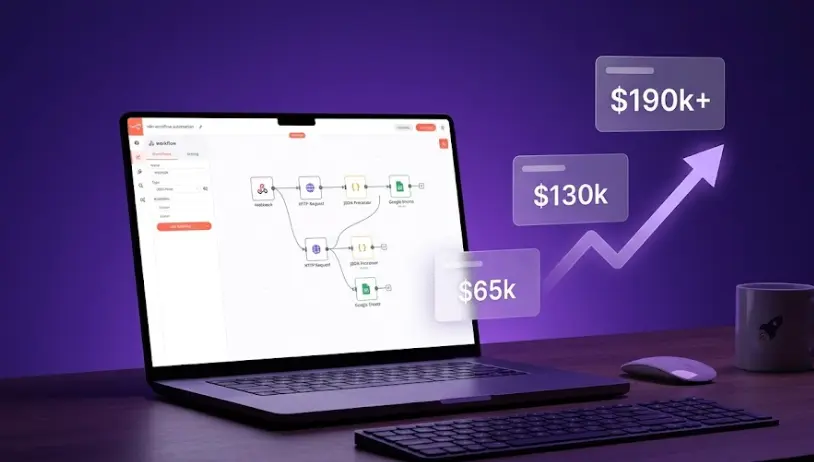
The honest answer is that "n8n developer" is four different jobs with four very different income ceilings. Someone maintaining existing workflows and connecting pre-built integrations earns $65,000–$85,000. Someone designing AI agent systems that process enterprise data at scale earns $160,000–$190,000+. Both carry the same job title. What determines which track you're on — and how to move between them — is a question of specific skills, not years of experience. This breakdown covers the real numbers from July 2026 job data, what moves the needle, and what the freelance market pays versus employed positions.
2026 salary snapshot — US market
Sources: ZipRecruiter (July 2026 n8n developer data: $40–$72/hr), Glassdoor (average $122,139/yr), agentic-engineering-jobs.com ($146k–$189k for senior/agentic roles). Freelance ceiling is for direct-client specialists — Upwork rates are typically 20–30% lower for the same skill level.
In this guide
- The four n8n developer levels and what they actually do
- Skills that move your salary — with actual impact numbers
- Freelance rates: Upwork vs direct clients vs agencies
- Employed vs freelance — which pays more in total
- Salary by location: US, EU, remote-from-anywhere
- The path to senior pay — what to build and when
- FAQ
The four n8n developer levels and what they actually do
Job boards list "n8n developer" as if it's a single role with a single salary. It isn't. The work ranges from configuring existing workflow templates to building AI agent systems that handle thousands of decisions per day. The compensation difference between the bottom and top of that range is over $100,000/year. Understanding where you fall — and what the next level actually requires — is more useful than knowing any average.
Automation Specialist
This is the entry point — someone who knows n8n's node library well, can connect the standard integrations (Gmail, Slack, HubSpot, Google Sheets, Airtable), and can configure trigger/action workflows without writing code. Most work involves maintaining existing automation stacks, documenting workflows, and handling small scope changes when business processes evolve.
Common job titles: Automation Specialist, No-Code Developer, Workflow Administrator, Integration Specialist. Employers at this level are typically SMBs or agencies that want someone to own their automation stack without hiring a full developer. The work is meaningful but the ceiling is set by the role's scope — there's limited leverage to demand more without expanding into code or system design.
Workflow Developer
This is where most n8n job postings land. A workflow developer can build complex multi-step pipelines from scratch, write JavaScript in Code nodes for data transformation, work with webhooks and REST APIs, design error handling and retry logic, and self-host n8n instances. They're comfortable with JSON data structures, authentication flows (OAuth, API keys, JWT), and debugging failed executions by reading logs.
What moves you from Specialist to Developer: the ability to build something that doesn't exist yet (as opposed to configuring something that someone else designed), and the ability to handle APIs that don't have native n8n nodes. Companies paying $90k–$130k typically need automation that integrates with their proprietary systems or less-common tools — that requires the HTTP Request node and custom logic, which require code fluency.
Automation Engineer
At this level, the work shifts from building individual workflows to designing automation systems — deciding which processes to automate, how workflows should interact with each other, what data needs to be stored and where, and how to monitor everything at scale. Engineers at this level typically own self-hosted n8n infrastructure, write custom nodes when existing ones don't fit, and often mentor junior team members or review other developers' workflows.
The salary jump from Developer to Engineer is the largest per-step increase in this field, and it's driven by two things: system design judgment (knowing not just how to build something but whether it should be built that way) and the ability to own a production automation stack without supervision. Companies paying this range expect you to be accountable for the reliability of systems that touch core business processes.
AI Automation Engineer
The fastest-growing segment in 2026. An AI automation engineer builds n8n workflows that incorporate large language models (OpenAI, Anthropic, local models) as decision-making components — not just simple text generation, but AI agents that can call tools, maintain context across steps, and take actions based on unstructured data inputs. This includes building AI-powered customer support triage, document processing pipelines, autonomous research workflows, and multi-agent systems where n8n orchestrates multiple AI components.
What separates this from standard automation engineering is the requirement to understand LLM behavior, prompt engineering for reliable outputs, token cost management, and how to build feedback loops that catch and correct AI errors in production. The n8n AI agent tutorial covers the technical foundations. The salary premium is real because this skill set is genuinely rare — most n8n users have never built a production AI agent system, and companies increasingly need people who have.
Freelance rates: Upwork vs direct clients vs agencies
Freelance n8n rates vary by platform, specialization, and whether the client found you or you found them. The platform you use changes your effective rate significantly — not because the work is different, but because of competition structure and fee models.
| Channel | Typical rate range | Reality |
|---|---|---|
| Upwork — new profile | $25–$45/hr | First 3 months. Platform takes 20% on first $500/client. Profile completion and early reviews matter more than rate. |
| Upwork — established (5+ reviews) | $50–$85/hr | After first 5-star reviews. Platform fee drops to 10% above $500 per client. Rate can increase 30–40% vs starting rate. |
| Upwork — specialist/Top Rated | $80–$130/hr | With a defined niche (AI agents, enterprise CRM, e-commerce ops). Top Rated badge reduces need for price competition. |
| Direct clients (warm outreach) | $75–$150/hr | No platform fee. Client came through referral or direct relationship. Often higher trust = less price pressure. |
| Agency subcontractor | $40–$70/hr | Lower rate, but consistent volume and no sales effort required. Agency takes margin, you get reliable pipeline. |
| Enterprise/consulting retainer | $120–$200/hr | Typically project-based or retainer. Requires established reputation, case studies, possibly a business entity. Hardest to enter, highest ceiling. |
A practical income calculation: at $75/hr direct-client rate, 30 billable hours/week, 48 working weeks per year = $108,000. At $100/hr for 25 billable hours (accounting for admin, sales, and gaps) = $120,000. At $130/hr for 20 billable hours (senior specialist with premium clients) = $124,800. The math shows that the rate matters less than utilization — getting to 70–80% utilization is harder than raising rates, especially early on.
Annual income at different freelance scenarios
The retainer agency model (covered in depth in the n8n automation agency guide) is the highest-ceiling income path for a solo n8n practitioner. It doesn't require more technical skill than freelancing — it requires a different business model and the willingness to be responsible for ongoing workflow performance rather than just delivery.
Build the skills that reach the $130k+ range
The AI Apps course covers n8n AI agent development, custom integrations, and the workflow architecture skills that separate mid-level from senior compensation — structured so you can apply them to real client work within weeks.
Try a Free LessonEmployed vs freelance — which pays more in total
The honest comparison requires accounting for what employment includes that freelancing doesn't: health insurance ($5,000–$15,000/year value if replaced independently), 401k/pension matching (3–6% of salary), paid time off (10–15% of your working time), and zero sales/marketing overhead. These benefits are worth $15,000–$30,000/year to most people. A $130,000 employed salary is closer to $150,000–$160,000 in total compensation when benefits are included.
On the freelance side, the upside is real but often overstated. At $85/hr fully utilized, you make $119,000 — before self-employment taxes (15.3% on top of income tax), health insurance, software subscriptions, and time lost to proposal writing, client management, and gaps between contracts. Net effective income is typically 25–35% less than the hourly rate implies.
+ $7k 401k match (5%)
+ $15k PTO value (15 days)
+ $5k other benefits
Total: ~$179,000 equivalent
− $18k self-employment tax
− $12k health insurance
− $6k software + tools
Net: ~$84,000 take-home
The math shows that freelancing at $100/hr 25 hours/week delivers similar net income to an employed role at $110,000–$120,000 — not $140,000. Freelancing beats employment financially when you can either charge significantly higher rates ($150+/hr) or build toward the agency model where your income isn't capped by your personal hours. See the full breakdown in the n8n income models guide.
The best financial case for freelancing isn't the hourly rate arbitrage — it's the optionality. A freelancer with 3 retainer clients at $1,500/month ($54k MRR) who also takes 1–2 projects/month at $2,000 each is earning $78k/year with 20 hours/week of work. That leaves 20 hours/week to build templates, write content, or pursue agency-model growth. Employed roles rarely offer that leverage.
Salary by location: US, EU, remote-from-anywhere
Location matters less in 2026 than it did five years ago — n8n roles are predominantly remote — but it still sets the baseline expectation for what employers consider normal compensation. The spread between a US-based role and a remote-from-Eastern-Europe role is still 2–3× for equivalent skill levels.
| Location / Context | Salary Range (employed) | Freelance Rate |
|---|---|---|
| United States — major tech hubs | $110k–$190k | $75–$200/hr |
| United States — other regions | $85k–$155k | $60–$150/hr |
| United Kingdom | £55k–£90k | £50–£120/hr |
| Germany / Netherlands | €65k–€110k | €60–€130/hr |
| Remote (Eastern Europe, hired by US cos) | $55k–$100k | $35–$90/hr |
| Remote (Latin America, hired by US cos) | $40k–$80k | $30–$75/hr |
| n8n.io company (EMEA remote) | €150k–€209k total comp | — |
The n8n.io company figures (from Levels.fyi) are worth noting as an outlier — they reflect a VC-backed Series B startup paying competitive European tech salaries, not the typical market rate for n8n work in Europe. Most n8n roles at European companies pay €65k–€90k for mid-to-senior level, significantly below what a US-based hire would cost.
For remote-from-anywhere freelancers, the practical question is where your clients are, not where you live. A developer in Warsaw charging $80/hr to US clients earns significantly more than the local market rate while paying local taxes — a financial arbitrage that works as long as the client relationship supports international billing.
The path to senior pay — what to build and when
Most salary guides for n8n developers suggest "get more experience" and "develop skills" without specifying what that means in practice. Here's the concrete sequence — organized by where you are now and what moves you to the next bracket.
mo
Foundation: $65k range → qualify for $85k
Master n8n's core node library: HTTP Request, Set, IF, Switch, Function, Merge, Loop Over Items. Build 10 real workflows (not tutorials — actual things that do something useful). Get comfortable with webhook triggers and reading/writing to Google Sheets or Airtable. Learn to read API documentation and use the HTTP Request node against any API. Start with n8n's free cloud tier, then set up a self-hosted instance on a $6/month VPS. By the end of this phase, you should have 3 portfolio workflows that solve real problems and be able to describe the business impact of each one.
mo
Skill expansion: $85k range → qualify for $110k
Add JavaScript fundamentals and use them in Code nodes: array methods (map, filter, reduce), object manipulation, async/await patterns. Build a complete workflow that processes data through a multi-step pipeline with error handling and a fallback notification. Learn to write n8n expressions fluently. Deploy a self-hosted n8n instance with a proper domain, SSL, and uptime monitoring — and keep it running for at least 3 months with real workflows. Take your first paying project or employment role. Your target at this stage is 3–5 paid projects with documented outcomes (reduced X by Y, saved Z hours/week).
mo
Specialization: $110k range → qualify for $140k
Pick a vertical (industry) AND a horizontal (workflow type). Example: "SaaS trial conversion automation" or "real estate lead routing systems." Build 2–3 deep case studies in that intersection. Add one enterprise tool (HubSpot, Salesforce, or similar) to your skill set and understand its data model well enough to design workflows around it, not just connect to it. Write about what you're building — LinkedIn posts, a Notion case study, or a short article. By month 24, you should have a track record of solved business problems, not just technical capabilities.
mo
AI premium: $140k range → $165k+
Build production AI agent workflows — not demos, but systems that run in production and handle real data. The n8n AI Agent node + OpenAI or Anthropic API + custom tool definitions is the technical combination; the hard part is building systems that fail gracefully when the LLM outputs something unexpected. Complete 2–3 real AI agent builds for clients or employers. At this point, apply for roles titled "AI Automation Engineer," "Agentic Systems Developer," or "Automation Architect" — these are the job categories where $155k–$190k is the norm, not the ceiling. The n8n AI agent tutorial is a good starting point for the technical side.
The fastest path to each bracket isn't self-study — it's working on harder problems than your current skills can handle. If you can solve a project in 4 hours, you're not learning. If it takes you 3 days and two failed attempts, you are. Take projects slightly above your comfort level; that's what accelerates compensation trajectory faster than any certification or course alone.
Related guides on learnforge.dev
Accelerate your path to senior n8n pay
The LearnForge AI Apps course teaches n8n, AI agent development, and the workflow architecture skills that employers and clients pay premium rates for — structured for people who want results, not certificates.
Start Learning for Free