n8n Course Vancouver: Best Way to Learn Automation in BC 2026
Vancouver's no-code automation market is moving fast — a local startup called Gumloop just raised $50M to build a drag-and-drop automation tool out of a bedroom in Vancouver. Meanwhile, n8n freelance work in BC pays CAD $80–$150/hour, and BC's own privacy law (PIPA) makes self-hosted n8n more than just a cost decision. Here's exactly how to learn it and what to do with the skill.
The short answer for Vancouver professionals
n8n is a visual workflow automation tool that connects apps without code — 400+ integrations, native AI agent nodes, and a self-hosted option that keeps your data on Canadian servers. For BC businesses handling personal data, self-hosted n8n on a Vancouver VPS is the cleanest way to comply with PIPA BC, which is stricter than federal PIPEDA.
Training options in Vancouver: NobleProg runs instructor-led n8n courses onsite or online (CAD $1,500–$2,500, 2 days). UBC Extended Learning covers automation strategy and no-code platforms within its AI micro-certificate (~$1,200–$1,800, broader scope). LearnForge's AI Apps course goes deepest on n8n specifically — from zero to building AI agents and real client workflows — and Module 0 is free.
The skill is worth learning: 43+ n8n and automation roles are actively hiring across Canada right now, Metro Vancouver automation specialists earn CAD $52,000–$95,000 depending on the role, and freelance project rates in BC run CAD $80–$150/hour.
What's covered
- Why automation is moving fast in Vancouver right now
- BC's PIPA privacy law and what it means for your tool choice
- n8n training options for Vancouver professionals
- What a solid n8n course teaches you
- What Vancouver clients actually hire for
- n8n vs Zapier vs Make — Vancouver context
- Salaries and freelance rates in BC
- FAQ
Why automation is moving fast in Vancouver right now
Vancouver's tech scene runs on a different axis than Toronto's. The Lower Mainland has a dense cluster of gaming studios (Electronic Arts, Riot Games, Capcom), enterprise software companies, and a growing SaaS corridor running from Gastown through False Creek and out to Burnaby and Richmond. Amazon has over 3,000 engineers in Vancouver. Microsoft, Apple, and Google all have significant BC offices. That concentration of tech infrastructure has made the city unusually receptive to automation tooling — the people who evaluate and buy these tools work in buildings full of them.
What's harder to see from the outside is how much of the opportunity is in the small and mid-market business layer underneath that enterprise layer. Gastown is full of marketing agencies, design studios, and tech-adjacent service businesses that are managing their client workflows in a mix of spreadsheets, email threads, and manual Slack messages. These businesses don't need a developer — they need someone who can connect their existing tools (HubSpot, Shopify, Notion, QuickBooks, Calendly) and make the repetitive parts run themselves. That's exactly where n8n skills translate into immediate, paid work.
The most telling signal about Vancouver's automation trajectory: in March 2026, Gumloop — a no-code automation startup that began in a Vancouver apartment — raised a $50M Series B. Gumloop is essentially drag-and-drop automation, the same category as n8n. The fact that a company doing that in Vancouver just raised $50M tells you what the market thinks about demand for these skills in the next few years.
BC's PIPA law and what it means for your automation tool choice
British Columbia has its own provincial privacy legislation — the Personal Information Protection Act (PIPA BC) — that governs how private-sector organizations collect, use, and disclose personal information about BC residents. It operates alongside federal PIPEDA, and legal experts consistently classify PIPA BC as stricter in several respects: more granular consent requirements, narrower exceptions for business purpose, and a broader definition of what counts as personal information.
For workflow automation, the practical implication is straightforward: if your automation processes personal data about BC residents — their names, email addresses, phone numbers, purchase history, health-adjacent information — and that data passes through a US-hosted service, you're in PIPA BC territory. Zapier's servers are in the United States. Make's servers are in the EU and US. When a BC law firm's Typeform lead submission runs through Zapier to land in HubSpot, that person's name and contact details just touched a US server. Whether that's a problem depends on how the firm has configured its consent language and whether it has a data processing agreement with Zapier.
PIPA BC requires that personal information not be transferred outside Canada or disclosed to a third party without consent or a contractual arrangement ensuring comparable protection. Zapier and Make are US-based processors. If you're in law, accounting, healthcare-adjacent services, real estate, or financial services in BC, passing client data through these platforms without proper data processing agreements creates compliance exposure. n8n self-hosted on a Canadian server eliminates this problem entirely — your workflow execution data never leaves the server you control.
The practical hosting options for PIPA-conscious businesses in Vancouver: Web Hosting Canada (WHC) operates a Vancouver-region datacenter and offers VPS plans starting around CAD $15–$25/month where n8n can run in a Docker container. AWS Canada Central (Montreal) and Azure Canada Central are also options. Any of these keeps your n8n execution data, credentials, and workflow history on Canadian soil under Canadian jurisdiction.
n8n training options for Vancouver professionals
NobleProg — Instructor-Led n8n Training in Vancouver
In-person at your office or online live, 2-day formatNobleProg is the most established provider of n8n instructor-led training in Canada, with Vancouver listed alongside Toronto and Montreal as delivery locations. The format is a 2-day live session — either onsite at your Vancouver office or via interactive remote desktop. The curriculum covers n8n fundamentals, workflow building, API connections, and an overview of n8n's newer AI-enabled features.
Pricing runs CAD $1,500–$2,500 per person for the 2-day course, which makes it practical for companies covering the cost but steep for individual career-switchers or freelancers. The instructors can adapt content to your specific use cases, which is genuinely useful if you're a team with known workflows you want to automate — rather than a solo learner trying to build a general skill set.
The gap in the NobleProg curriculum is AI agents. The course covers connecting standard services (Gmail, Slack, Sheets) and building scheduled workflows, but the n8n AI Agent node — which lets you wire GPT-4 or Claude into decision-making workflows — isn't a focus. For client work in 2026, that gap matters, because AI-powered automations are where the interesting projects and higher rates live.
UBC Extended Learning — AI-Powered Automation Micro-Certificate
Strategic focus, no-code tools included, UBC credentialUBC Extended Learning offers an AI-Powered Automation and Personalization micro-certificate, along with a standalone course called AI Strategy: Leveraging Automation. Both use no-code platforms as part of the curriculum and require no coding experience. They're well designed for managers, marketing leads, and business decision-makers who need to understand automation strategy rather than build workflows day-to-day.
The micro-certificate program covers tool selection, implementation frameworks, AI automation strategy, and practical exercises with no-code platforms — but it's not n8n-specific. You won't leave it knowing how to build an HTTP Request node workflow or wire an AI agent. You will leave it with a structured mental model for evaluating automation opportunities and a UBC credential that reads well on a resume in the BC market.
Pricing varies by course and intake — typically CAD $1,200–$1,800 for the standalone AI Strategy course, more for the full micro-certificate program. UBC's programs also qualify for BC's Pacific Leaders or Skills for Jobs BC funding in some cases, which can reduce out-of-pocket costs for eligible applicants.
LearnForge AI Apps Course — n8n from Zero to AI Agents
Self-paced, Module 0 free, covers AI agents and real client projectsLearnForge's AI Apps course is the option that goes deepest on n8n specifically. It's built for people who want to actually build things — not just understand the concept — and covers the full arc from first workflow to production AI agents. Module 0 is free and gets you through n8n fundamentals (nodes, triggers, data flow, your first working automation) without any credit card or sign-up friction.
The paid modules go into the skills that translate directly to client work: HTTP Request nodes for connecting any API (including the Canadian-specific tools that aren't in n8n's native integration library), conditional logic and error handling, building AI agents using the n8n Agent node with GPT-4 or Claude, sub-workflows for complex multi-step processes, and FlutterFlow for building no-code frontends. By the end, you have 5 production automations that are real deliverables, not toy examples.
For Vancouver professionals specifically: self-paced means no timezone constraints, no cohort schedule to hit, and the ability to go deep on whatever area matters most to you. Someone working in Vancouver's hospitality industry might focus on the reservation management and guest messaging workflows; someone in the Gastown agency world might focus on client reporting and lead pipeline builds. The material supports both paths.
Udemy n8n Courses
Video-based, variable quality, CAD $15–$25 on saleUdemy's n8n library has grown significantly — several courses now have 15,000–40,000 students enrolled and cover everything from basic workflow building to AI agent pipelines. The best-rated ones (sort by "Highest Rated" within the n8n category) are genuinely good video introductions: you see someone build real workflows step by step, and you can pause and replicate each step immediately.
The caveats are predictable: Udemy doesn't vet instructors for accuracy, update frequency varies wildly, and the quality gap between a 4.6-star course and a 3.8-star course is enormous. Stick to courses updated in 2026, with at least 5,000 students, and a preview that shows actual n8n canvas work rather than slides. The pricing — CAD $15–$25 during Udemy's near-constant promotions — makes this the lowest-risk entry point for testing whether you enjoy the tool before committing to a longer course.
Start with Free — Build Your First n8n Workflow Today
LearnForge's AI Apps course covers n8n from zero to production AI agents and real client projects. Module 0 is completely free — no credit card, no email wall. Professionals across Vancouver and BC are using it to learn the skills that pay CAD $80–$150/hour.
Start Free Module →What a solid n8n course teaches you
The skills that matter for real n8n work break into five areas. A course that covers all five is worth your time; one that stops at the first two is giving you a demo, not a skill.
Nodes and data flow. Every n8n workflow passes JSON data from node to node. You reference that data using expressions like {{ $json.customerEmail }}. Most beginners struggle here first — once you understand how data flows and how to access it at each step, everything else becomes easier. Good courses spend a lot of time here, usually 20–30% of the total content.
Triggers. n8n workflows start on a Schedule trigger (runs on cron-like timing), a Webhook trigger (fires when an external service sends an HTTP request to your n8n URL), or a service-specific event trigger (new Stripe payment, new Gmail email, new row in Google Sheets). The difference between these trigger types determines the whole architecture of a workflow. Most client automations use webhook triggers at the start.
HTTP Request node. This is the single most powerful node in n8n. It makes arbitrary API calls — GET, POST, PUT, PATCH, DELETE — with custom headers, authentication, and body payloads. The 400+ native n8n nodes are convenient, but anything that has a REST API works through the HTTP Request node. For Vancouver specifically, this includes BC-specific tools: the BC Assessment API for property data, WorkSafeBC reporting integrations, or custom ERP APIs used by manufacturing businesses in the Lower Mainland.
Conditional logic and error handling. The IF node routes workflow execution down different paths based on data values. The Switch node handles more than two paths. Error Trigger workflows catch failures in other workflows. Without these, your automation breaks silently when it hits an edge case. With them, it degrades gracefully and notifies someone.
AI Agent node. Added in n8n version 1.x, the AI Agent node lets you wire an LLM — GPT-4, Claude 3.5 Sonnet, Llama 3 — into a workflow as an autonomous decision-maker. You give it a system prompt, a set of tools (search the web, query a database, send an email, look up a calendar), and an input. It decides which tools to use and in what order. This is where 2026 client demand is concentrating — businesses want AI that acts, not just AI that generates text.
What Vancouver clients actually hire for
Vancouver's industry mix produces specific automation demand that you won't find in, say, Calgary or Ottawa. The five highest-demand workflow categories in the Lower Mainland right now:
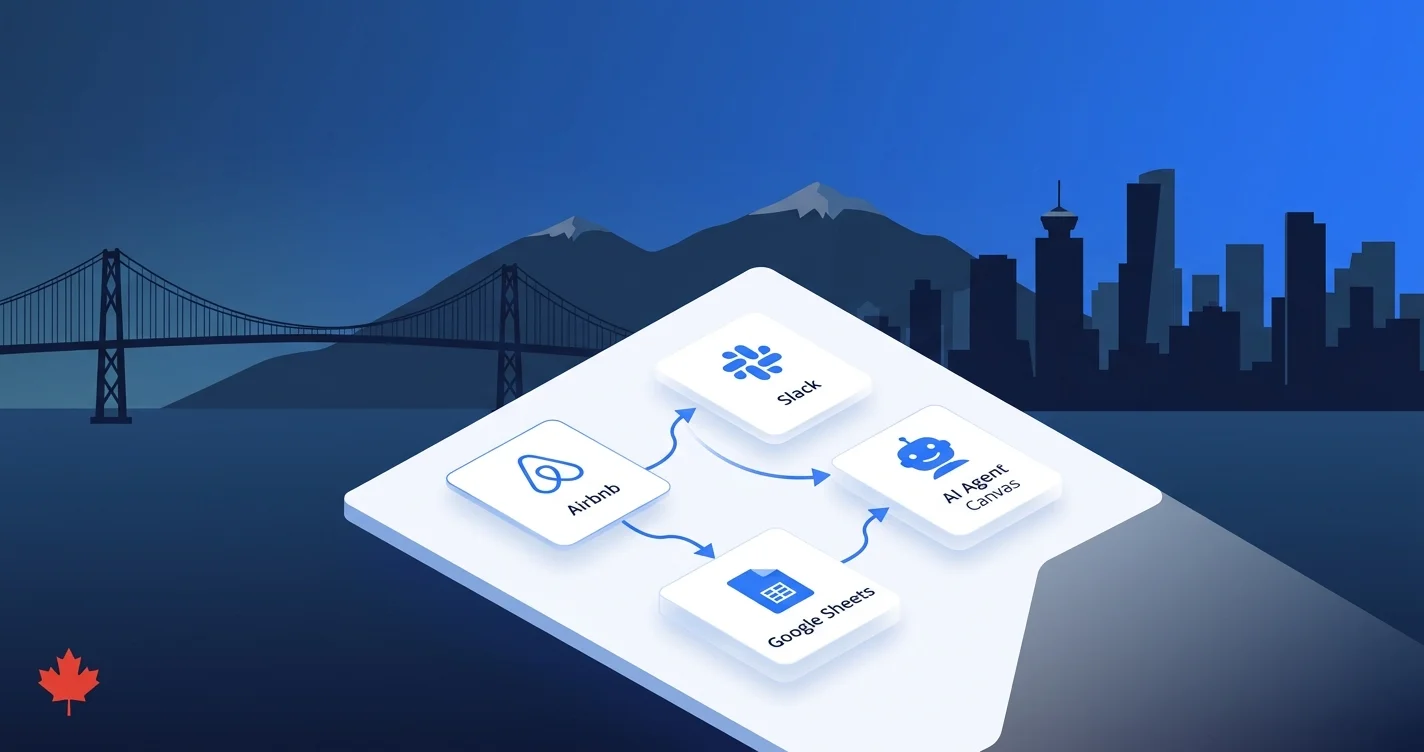
The short-term rental case is worth spelling out because it's uniquely Vancouver-sized. The Whistler Blackcomb corridor, Gulf Islands properties, and Airbnb hosts throughout Metro Vancouver are managing check-in logistics, cleaning crew coordination, and guest communication mostly by hand. A typical n8n automation for a 5-property Airbnb host: Airbnb new booking webhook → parse check-in/check-out dates → Google Calendar blocked + cleaning crew SMS (via Twilio) on check-out day → automated guest pre-arrival email 48 hours before check-in → automated review request 24 hours after check-out. That workflow saves about 45 minutes per booking. A host with 80 bookings per year saves 60 hours — every year, automatically.
Build time for that workflow: 6–8 hours for someone with 10–15 hours of n8n experience. At CAD $100/hour, that's a $600–$800 project that delivers ongoing value to the client for years without further maintenance. Referrals in the short-term rental community in BC travel fast — this type of project has a high word-of-mouth multiplier.
How to land your first Vancouver automation client
The fastest path: build 3–4 demo workflows targeting specific Vancouver industries — a real estate agent's lead routing system, a restaurant's reservation-to-staff notification pipeline, an Airbnb host's check-in automation. Record each as a 3-minute Loom showing it running in real time.
Share in: Vancouver Tech Jobs (Slack community), Vancouver Entrepreneurs Facebook group, Yaletown-area professional networks, and LinkedIn with the Loom attached. The Gastown startup and agency community is small and connected — one visible demo in the right channel often generates 3–5 inbound conversations. Most Vancouver small business owners have never seen n8n run live and are genuinely surprised at how much it can handle without code.
n8n vs Zapier vs Make — honest comparison for BC businesses
The three tools serve different parts of the market. For BC businesses specifically, the PIPA angle adds a fourth variable that doesn't apply in most jurisdictions.
For a Vancouver marketing agency running 300–500 automation tasks per month: Zapier's Starter plan ($19.99 USD/month, 750 tasks) is often the fastest to set up and the most familiar to clients. Make's Core plan ($9 USD/month, 10,000 operations) handles the same volume for less money and supports more complex conditional logic. Both are fine choices for agencies where workflows don't handle regulated personal data and don't involve AI agents.
n8n self-hosted on a Canadian VPS makes clear sense in three Vancouver-specific scenarios: a law firm in the West End routing client intake through an automation that touches privileged communications; a clinical support business in Burnaby processing patient-adjacent data under BC health privacy rules; or a high-volume e-commerce operation in Richmond running 10,000+ automation executions monthly where Zapier would cost $200+/month. In all three cases, the CAD $15–$25/month VPS cost plus the time to learn n8n is a better deal than either the compliance risk or the Zapier invoice.
Learn n8n the Right Way — Client Projects From Day One
LearnForge's AI Apps course is built around the skills Vancouver freelancers and operators need to start charging for automation work. Start with the free module — no credit card, no catch. Build your first working workflow in under 2 hours.
Try Free Module →Salaries and freelance rates in BC
The Vancouver job market for automation skills is more varied than Toronto's because of the city's mix of enterprise tech companies, gaming studios, agencies, and small businesses. The same underlying skill — building n8n workflows — gets packaged into different job titles depending on the employer.
Operations & Automation Specialist — CAD $52,000–$70,000/year. These roles (common at Vancouver SaaS companies, marketing agencies, and logistics companies in the Lower Mainland) involve building and maintaining automation workflows, managing integrations between business tools, and training team members on new systems. n8n is often listed alongside Zapier, Make, or HubSpot workflows as required experience.
AI Tools / Automation Manager — CAD $70,000–$95,000/year. More senior roles at larger Vancouver companies (tech scale-ups, enterprise services firms, Amazon or Microsoft BC teams) that involve owning the automation infrastructure and making tool selection decisions. Python scripting or data pipeline experience often pairs with n8n at this level.
Freelance n8n consultant — CAD $80–$150/hour. The freelance market in Vancouver and the broader BC market (Victoria, Kelowna, Kamloops all have active small business communities) rewards consultants who can show working examples before the first call. Project rates are more common than hourly for defined-scope builds — a lead pipeline automation might be quoted at CAD $600–$1,200 as a flat project, a more complex AI-powered system at CAD $2,000–$4,000. Ongoing retainers for monitoring and expansion are common after the initial project.
FAQ
Related Articles
n8n Automation Course in Toronto: Learn No-Code AI in 2026
37+ active n8n positions in Toronto, CAD $75–$150/hour freelance rates, training options compared.
n8n AI Agent Tutorial: Build a Production-Ready Agent Without Code
Configure the AI Agent node, add memory, connect live tools — step by step, no code required.
n8n vs Zapier: Full Comparison for 2026
Price, execution limits, AI support, self-hosting — everything that matters when choosing between the two.
Ready to Start? Module 0 Is Free.
The LearnForge AI Apps course is built around what Vancouver and BC professionals need to take automation clients or bring the skill into their current role. No coding required, no credit card for Module 0.
Start Free Module →